Page History: Test and Validation
Compare Page Revisions
Page Revision: 2010/09/24 15:57
Overview
A single degree of freedom structure represented by an inverted pendulum is one of the simplest examples used by the civil engineers to explain the fundamentals of the dynamics of structures. In this work, this structure was also used as a tool to evaluate and understand the behaviour of the developed prototype for operational modal analysis of civil engineering structures. The laboratory specimen consists in an inverted wooden pendulum with 1.70 m height built specially for testing purposes in the civil engineering laboratory at the University of Minho. The pendulum was designed in such a way that its dynamic properties replicates the properties of the Mogadouro´s Clock Tower, an old masonry tower in the northern part of Portugal
link for the Luis Ramos’ studied that led to the development of the pendulum.
Testing COTS technologies
For comparison purposes, both WSN platforms (full COTS solutions based on MICA2 platforms and MTS400 sensor board, and the project prototype system) were evaluated considering as references conventional wired based systems which consist in high sensitivity piezoelectric accelerometers model PCB 393B12
link as well as the NI-USB9233
link as data acquisition board.
The initial tests were meant to observe the performance of the COTS technology on WSN platforms for dynamic monitoring studies. With this purpose, the accuracy of the time series recordings of these platforms (MICA2 + MTS400 sensor board) was evaluated using only one of the conventional accelerometers and placed at the top of the Pendulum.
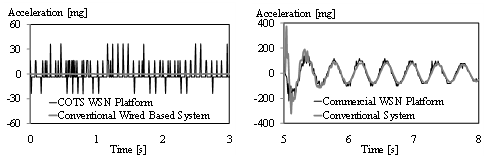
The results of the first test indicated the good performance of the commercial WSN platforms for measuring high amplitude vibrations. As it was expected, for signals with amplitudes below 20 mg, the WSN platforms recorded only noise (it is even feasible to observe the digitalizing lines) due to the low resolution of the micro-accelerometers and the ADCs embedded. However, it is important to state that in SHM studies of civil engineering structures, vibrations with amplitudes below 2 mg are commonly found. Moderate differences (less than 5%) were found in the frequencies detected with both systems (wired and COTS WSN) as well as meaningless results for the mode shape detection task due to the lack of the implementation of synchronization algorithms in the commercial WSN platforms.
The initial tests were meant to observe the performance of the COTS technology on WSN platforms for dynamic monitoring studies. With this purpose, the accuracy of the time series recordings of these platforms (MICA2 + MTS400 sensor board) was evaluated using only one of the conventional accelerometers and placed at the top of the Pendulum.
The results of the first test indicated the good performance of the commercial WSN platforms for measuring high amplitude vibrations. As it was expected, for signals with amplitudes below 20 mg, the WSN platforms recorded only noise (it is even feasible to observe the digitalizing lines) due to the low resolution of the micro-accelerometers and the ADCs embedded. However, it is important to state that in SHM studies of civil engineering structures, vibrations with amplitudes below 2 mg are commonly found. Moderate differences (less than 5%) were found in the frequencies detected with both systems (wired and COTS WSN) as well as meaningless results for the mode shape detection task due to the lack of the implementation of synchronization algorithms in the commercial WSN platforms.
Time domain series recorded using COTS WSN platforms: (left) low amplitude excitation recordings; (right) higher amplitude excitation recordings.
Testing Portotype Platform
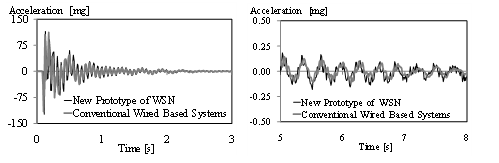
A replication of the previously described test was preformed also with the project’s prototype to obtain a performance comparison between both.
Results demonstrate that, even for signals with amplitudes below than 0.25 mg, the records from the new developed WSN platform and the conventional wired based accelerometers presented a remarkable degree of similarity.
Time domain series recorded using the developed prototype of WSN platform: (left) High amplitude excitation recordings; and (right) lower amplitude excitation recordings.
Frequency content and Modal Shape Analysis
Further tests consisted on the verification of the accuracy of the frequency content of the acquired signals with the project’s prototype. Considering the same pair of sensors located at the top of the pendulum and 30 s of sampling time, experiments in two excitation scenarios were carried out: random impacts tests (vibrations with amplitudes below 5 mg) and ambient noise tests (vibrations with amplitudes below 1.5 mg). The Welch Spectrums
link of the time series records were calculated and are presented:
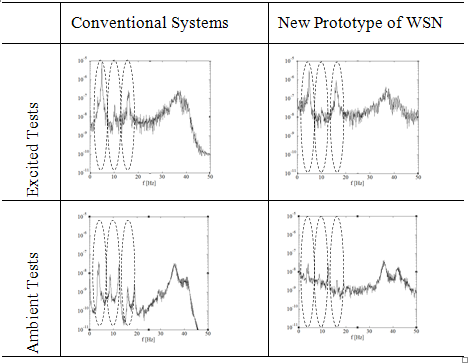
The results evidenced the high accuracy of the resultant frequency domain spectrums calculated from the records of the new developed prototype in comparison with conventional wired systems. With this respect, even in the case of ambient noise tests, outstanding similarities in the content of frequencies were detected.
The last stage of the experimental operational modal analysis process consists on the estimation of the dynamic properties of the structures by means of their natural frequencies, damping coefficients and mode shapes. For this purpose, a more refined data processing method was used which consisted on the evaluation of the time series recordings with three conventional wired sensors and three new developed prototypes located at the top of the pendulum using parametric time domain techniques such as the Stochastic Subspace Identification (SSI) method
link for this (Van Overschee; and De Moor, 1991). The obtained results of this analysis for the case of random excited system are presented.
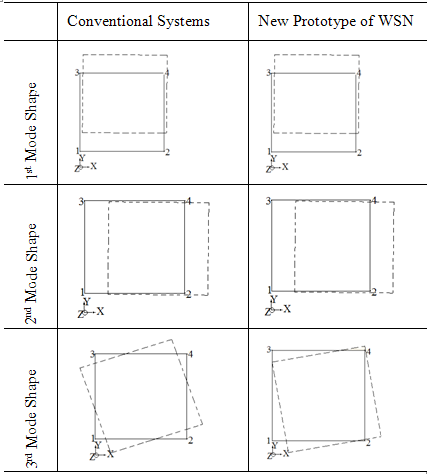
The results of the experimental modal identification studies performed in the pendulum using the conventional wired based systems and the project’s prototype system are presented in the following table: